Samsung’s 471% Memory Revenue Surge: Decomposing the AI-Driven Earnings Explosion
A 471% increase in memory revenue is not a routine cyclical rebound. It is a signal that pricing, product mix, and customer demand have moved together with unusual force. For Samsung, the headline captures something larger than a strong quarter: artificial intelligence is changing where the semiconductor industry earns its money—and who ultimately pays for that transformation.

In the second quarter of 2026, Samsung reported memory revenue of KRW 120.8 trillion, up from KRW 21.2 trillion a year earlier and KRW 74.8 trillion in the previous quarter. The company reported growth of 471% year over year and 62% sequentially. These figures describe memory sales, not Samsung’s total revenue or a separately disclosed memory operating profit.
That distinction is the starting point for a useful decomposition. The surge was not simply “more AI chips.” It reflected more memory sold, higher prices, a richer product mix, and an industry supply response that could not immediately match demand.
The resulting earnings explosion was extraordinary. Whether it represents a lasting change in profitability is a different question.
Start With the Accounting, Not the Excitement
Samsung’s memory business belongs to its Device Solutions division, which also contains foundry and System LSI operations. The wider company includes smartphones, displays, appliances, and other businesses.
During the quarter, Device Solutions generated KRW 127.5 trillion in revenue and KRW 89.2 trillion in operating profit. Samsung Electronics reported consolidated revenue of KRW 171.5 trillion and operating profit of KRW 89.5 trillion.
Memory supplied most semiconductor revenue, but the division’s operating profit should not automatically be labeled memory profit. The reporting structure does not provide that clean separation.
Still, the comparison is revealing. Semiconductor operations generated almost as much operating profit as the entire company. Other businesses collectively contributed little to the consolidated result.
This was not a broad, evenly distributed improvement across Samsung. It was a semiconductor-led earnings event, with memory at its center.
The Three Engines: Price, Volume, and Mix

Memory revenue can be understood through three questions: how many bits were shipped, what buyers paid, and which products accounted for those shipments.
Samsung identified record bit sales in both DRAM and NAND, continued industry-wide price increases, and a record server revenue mix. It also highlighted expanding HBM4 sales.
These drivers reinforce one another. Higher shipment volumes enlarge the revenue base. Stronger prices increase the value of that output. A shift toward premium applications changes the economics of the portfolio.
However, Samsung’s disclosures do not provide a complete numerical bridge allocating the 471% increase among those three factors. Assigning exact contributions would create precision the available information does not support.
The defensible conclusion is narrower and more useful: the surge was not purely a pricing event, not purely a volume event, and not purely an HBM event. It was a combination.
Why Pricing Can Transform Earnings So Quickly
Memory manufacturing is capital intensive. Factories, process tools, maintenance, and engineering create substantial costs before the next chip is sold.
Those costs do not automatically rise in proportion to selling prices. When customers pay more for output from an existing manufacturing base, additional revenue can translate into disproportionately large profit gains.
Samsung’s consolidated figures illustrate this sensitivity. Between the first and second quarters, revenue increased from KRW 133.9 trillion to KRW 171.5 trillion. Cost of sales changed only modestly, from KRW 52.0 trillion to KRW 52.2 trillion. Gross profit consequently rose from KRW 81.9 trillion to KRW 119.3 trillion.
These company-wide figures are not a memory-specific cost model. Nevertheless, they show why earnings can accelerate much faster than physical production during a strong pricing cycle.
The same mechanism works in reverse. Factories do not become inexpensive to operate just because memory prices fall.
HBM Is the Flagship, Not the Entire Fleet
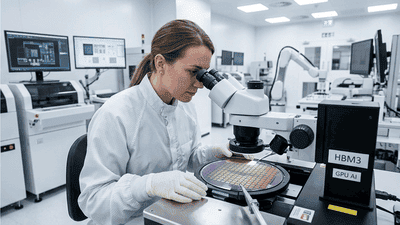
High-bandwidth memory attracts attention for good reason. Advanced accelerators need rapid access to data, and HBM’s stacked architecture and close integration with processors make it central to that requirement.
Samsung emphasized scaling HBM4 sales and shipping HBM4E samples to major customers. These developments indicate progress at different stages: commercial sales and customer sampling are not interchangeable milestones.
But AI infrastructure needs more than accelerator memory.
Host servers require DRAM. Storage systems require enterprise SSDs. Datasets, model files, and applications create demand across the memory hierarchy. Samsung identified server DRAM, enterprise SSDs, and HBM as important beneficiaries of continued AI infrastructure spending.
This broadens the macro story. The AI buildout can support multiple memory categories simultaneously, even though their manufacturing requirements, competitors, and pricing cycles remain different.
Reducing the revenue surge to HBM alone would miss much of the transmission mechanism.
The Less Visible Driver: Capacity Allocation
Demand receives the headlines. Production allocation often determines the consequences.
Manufacturers must decide how to distribute factory resources among products with different technical requirements and commercial returns. HBM uses DRAM manufacturing resources while adding demanding stacking, testing, and integration stages.
Expanding advanced-memory output is therefore not equivalent to switching a label on an existing chip.
When suppliers prioritize AI-oriented products, conventional DRAM supply growth can become constrained. That helps explain why customers outside the accelerator market may still encounter higher memory costs.
A PC manufacturer does not need to experience booming sales to face tighter component supply. Its suppliers may be directing resources toward more attractive server applications.
Samsung described constrained supply despite production-expansion efforts and expected continued undersupply even with some moderation in mobile and PC demand.
The cycle was being shaped by what factories produced, not simply by how much capacity they possessed.
Operating Leverage Turns Scarcity Into Profit

The financial mechanism behind the explosion is leverage: operating leverage, rather than necessarily greater borrowing.
Higher revenue allows fixed manufacturing costs to be absorbed against a more valuable sales base. Strong pricing and favorable mix can amplify the effect.
Samsung’s Device Solutions operating profit rose from KRW 53.7 trillion in the first quarter to KRW 89.2 trillion in the second. Its reported operating margin reached approximately 70%.
Such profitability calls for admiration and scrutiny in equal measure.
Technical capability may endure longer than scarcity pricing. A supplier can continue improving products while losing some pricing power. It can ship more bits while earning less on each additional unit.
The investment question is therefore not whether the company is performing well. It is how much of the performance reflects sustainable competitiveness and how much depends on unusually tight market conditions.
The Other Side of the Windfall
Samsung’s own consumer operations offered a striking counterpoint.
Device eXperience reported an operating loss of KRW 0.8 trillion, with rising component costs pressuring profitability despite year-over-year revenue growth.
What benefits a memory supplier can hurt a device manufacturer.
Higher chip prices force buyers to make uncomfortable choices: raise retail prices, accept lower margins, reduce specifications, or adjust production. None is painless in a competitive market.
Samsung’s integrated structure does not erase these tensions. Its divisions compete in different markets and have different abilities to pass costs through to customers.
The semiconductor upswing was consequently also a redistribution of profit across the electronics value chain. A booming upstream component market did not guarantee a healthy downstream market.
The Base Effect Matters—but Does Not Settle the Story
A small comparison base can produce an enormous growth percentage. That is an unavoidable part of interpreting the 471% figure.
Memory revenue of KRW 21.2 trillion in the second quarter of 2025 provided a much smaller denominator than the subsequent sales base.
Yet the sequential result prevents the surge from being dismissed as a statistical illusion. Revenue increased another 62% from the first quarter of 2026, when memory sales were already KRW 74.8 trillion.
The business was expanding from an elevated level, not merely recovering from the earlier comparison period.
Looking ahead, percentage growth will become harder to sustain as the denominator rises. That does not necessarily imply falling revenue or collapsing profit.
Growth-rate normalization and business deterioration are different developments. Analysts who confuse them risk misreading both the peak and the slowdown.
There Is No Single Semiconductor Cycle
Samsung’s results do not mean every chip category was enjoying the same conditions.
AI infrastructure spending can lift advanced memory and selected computing technologies while consumer demand remains softer. Foundry, System LSI, and memory also have distinct operational drivers.
Samsung’s presentation itself contrasted strong server demand with a softer mobile market.
This unevenness matters when discussing a global semiconductor “supercycle.” Industry totals aggregate businesses exposed to different customers, inventory positions, and investment schedules.
A memory boom can lift the headline while concealing weaker conditions elsewhere. A later memory slowdown could drag on that headline without proving that every semiconductor market has deteriorated.
The better framework is a set of overlapping cycles. AI infrastructure is currently a powerful organizing force, but it does not synchronize the entire industry.
Today’s Cash Can Become Tomorrow’s Supply
Extraordinary profitability gives manufacturers the means to expand. It also introduces the next cyclical risk.
Samsung reported KRW 105.08 trillion in second-quarter operating cash flow and KRW 14.11 trillion in purchases of property, plant, and equipment. Its broad reported cash measure reached approximately KRW 190 trillion at quarter-end.
Financial resources alone do not create immediate usable capacity. Expansion requires equipment, process development, qualification, and ramp-up. New output arrives with a delay.
That delay can sustain tight supply in the near term. Later, it can create excess capacity if competitors expand together or customer consumption disappoints.
Not every investment becomes memory production, and not every capacity addition serves the same product generation. Nevertheless, the central risk is familiar: suppliers make decisions under today’s scarcity conditions, then deliver capacity into tomorrow’s market.
The most profitable period can become the point at which the next imbalance begins.
What to Watch After the Explosion
The headline is backward-looking. Assessing durability requires watching what follows.
- Do shipments become productive customer deployments, or accumulate in inventory?
- Do advanced-memory ramps deliver acceptable yields and commercial returns?
- Can suppliers add output without weakening prices materially?
- Does server demand remain strong as the revenue comparison base rises?
- Do higher component costs increasingly suppress consumer-device demand?
These indicators connect supplier results to end-market consumption. They also help distinguish genuine infrastructure expansion from ordering amplified by fear of shortages.
No single data point resolves the cycle. The relationship among pricing, inventories, capacity, and utilization is what matters.
The Meaning Behind the 471%
Samsung’s revenue surge captured a rare convergence: more bits, stronger prices, richer products, and AI demand extending across the memory hierarchy.
The earnings demonstrated how quickly scarcity can improve semiconductor economics. The weakness in consumer operations demonstrated that the benefits have a cost elsewhere.
The next chapter will not be decided by repeating a spectacular growth percentage. It will depend on technical execution, investment discipline, and whether customers consume the infrastructure they purchase.
AI has changed the shape of the memory cycle. Samsung’s results show how powerful that change can be. They do not, by themselves, prove that the cycle has disappeared.